Against Regurgitation
A meditative manifesto for slow creativity

“A dog is going to bark. A cat is going to vomit.” —Roy Blount, Jr.
“I write one page of masterpiece to ninety-one pages of shit. I try to put the shit in the wastebasket.” —Ernest Hemingway
If you serve a cat – there is no owning a cat, only serving a cat – then you know about the Barf Olympics. Every cat, and I mean every cat, trains for it their entire life. But while many try, few succeed. The Barf Olympics is an elite arena. The competition is fearsome, the standards exceedingly high. Excellence requires more than effort or ability, more than strength, skill, timing, and artistry. Excellence requires transcendence.
I am convinced that Jenny Wren is that rare thing: a true contender for the Barf Olympics. Today, while sweeping the floor, I encountered evidence of her most recent training session: a skillfully choreographed routine that encompassed two dining room chair cushions, the floor between them, and the clawfoot of the antique oak table I gifted myself when I finished my PhD. The delicate spatter patterning the hardwood floor was reminiscent of Pollack; the molding of puke between the clawfoot’s wooden toes was a sculptural pun, the sort of thing Dali might have done, had he been less interested in melting clocks, more into dissolving meat. The joke of course was on me: cleaning the clawfoot left me with all manner of unmentionable crud under my nails, while Jenny's own dainty clawfeet remained pristine, her black pads supple as new suede, the long tufts between them impossibly, perfectly clean. All of which is to say, Jenny Wren totally stuck her landing.
Being an all-around barflete, Jenny Wren cross-trains on window sills, chair backs, bookshelves, countertops, and the occasional shower rail. I will leave it to you to imagine the cathleticism my beloved regurgitator brings to these events, the distance she achieves, the height, the precision — and, oddly, considering that she’s hurling hairballs — the grace. For Jenny Wren is an elegant regurgitator. She understands that peak performance is always ultimately its own kind of dance.
Jenny’s regurgitative practice requires scrubbing, and scrubbing always gets me thinking. On this day, around about the time I was using my thumbnail to get the last of the premium grain-free gunk out from between the claw-foot’s oaken toes, I got to thinking about regurgitation more generally, regurgitation as it pertains not just to digestion, but to our ideas about how we have ideas. Specifically, I got to thinking about how metaphors of vomiting, spitting, and spewing shape how we think about thinking, especially when it comes to creativity.

Jenny Wren warming up behind the wood stove. She looks harmless. We know better.
I. Regurgitation and the Problem of Fast Creativity
We chew on ideas. We swallow stories. We digest information. We spit out the truth. When angry, we spew venomous words. And, when we fail to think for ourselves — when we merely mouth the words of others — we are said to be regurgitating.
Regurgitation happens when we use cliche, platitude, and parroted expressions to present ourselves as thinking, when we are actually not thinking at all. Regurgitated ideas are everywhere, festering in plain sight, pretending to be original and true, and mostly getting away with it, because mostly they don’t get called out. When they do, it’s unforgettable — as in the bar scene in Good Will Hunting:
Here, Matt Damon makes himself abundantly clear: regurgitation is the garbage dump of a lazy mind, a mind that does not know itself, a mind that may be confused about where its thoughts end and those of others begin, a mind that may not even have its own thoughts at all.
(It’s no accident that when we are disparaging AI, we speak of it as “regurgitating” ideas, patterns, and styles it has ingested from human creators. Describing LLMs in this way — as brainless binge eaters that can only throw up undigested “slop” — allows us to think of them as unable to think, as passing for thinking, as nowhere near as good as the real, reasonable human thing.)
And so we speak of regurgitation as lazy, bad, and false — as the opposite of authentic human ratiocination. And yet, at the same time, we celebrate regurgitation as a powerful and generate creative technique.
Exhibit A: the vomit draft.
The concept of the vomit draft comes from the great Calvin Trillin, who I met by way of his Tummy Trilogy, a collection of food writing that I picked up in Philadelphia thirty-some years ago, and have kept with me through numerous moves and book-cullings, because I was so totally captured by his accounts of the food tours he would take of diners, barbecue joints, family restaurants, and other high-cal, lowbrow establishments in the American heartland. These trips featured extreme food crawls where Trillin would joyously gorge on fried chicken, ribs, pizza, burgers, fries, and similar, with zero concern for calories, let alone his arteries. Binging his way across entire metropolitan regions hunting for the perfect fried potato or the ultimate piece of pie, Trillin was on a hero’s junk food journey, totally at one with his quest. In other words, this is a writer who knows a thing or two about nausea, who comes honestlyby the concept of the vomit draft.
Here’s Calvin Trillin, describing his “vomit out” approach to writing:
Key point #1: Trillin uses the vomit draft diagnostically. When he’s preparing to write, rapidly disgorging words onto paper allows him to take an “inventory” of what’s in his mind, to capture thoughts in order to discern what might work for the piece he’s about to create. Then he throws the vomit draft out, which is exactly what one ought always to do with vomit, whether it’s made up of undigested food or unprocessed fragments of thought. Trillin rightly never looks at his word vomit again. He doesn’t try to edit it, revise it, shape it, or turn it into anything other than what it is, which is garbage.
Key point #2: We no longer think of the vomit draft as Calvin Trillin conceived of it — as a mess meant to be tossed, a disposable tool, a single-use item that loses its value the second we’ve purged the junk swirling in our heads. These days, in creative writing circles across the land, the vomit draft is an achievement, a precious chunk of raw artistic material ready to be honed into art. The vomit draft is no longer trash. The vomit draft is now a viable first draft. The vomit draft is creative gold.
How did this happen? Where did we get the idea that the vomit draft — the rapid, reflexive hurling of words onto paper or screen — is a good way to think original thoughts, let alone a good way to write meaningful prose? My money is on Anne Lamott, whose wise and witty advice book, Bird by Bird: Some Instructions on Writing and Life, has defined the creative process for generations of writers ever since it was first published way back in 1994.
Exhibit B: The shitty first draft.
In Bird by Bird, Lamott sings the praises of what she calls the ”shitty first draft,” a fast and furious mind dump that enables us to bypass the sheer pain of getting words out of our heads and onto the page:
The only way I can get anything written at all is to write really, really shitty first drafts. The first draft is the child's draft, where you let it all pour out, and then let it romp all over the place, knowing that no one is going to see it and that you can shape it later. You just let this childlike part of you channel whatever voices and visions come through and onto the page. If one of the characters wants to say, "Well, so what, Mr. Poopy Pants?," you let her. No one is going to see it. … Just get it all down on paper, because there may be something great in those six crazy pages that you would never have gotten to by more rational, grown-up means. There may be something in the very last line of the very last paragraph on page six that you just love, that is so beautiful or wild that you now know what you're supposed to be writing about, more or less, or in what direction you might go – but there was no way to get to this without first getting through the first 5 1/2 pages.
This description has had a tremendous impact on the way we’ve thought about creativity for the past thirty years or so. And it’s not hard to see why — it’s tremendously seductive.
The shitty first draft embodies a fantasy of fast, unfiltered, easy creativity — creativity without effort or struggle, creativity without confusion or error, creativity without the hard effort of decision and discernment. If we just spill words fast enough, if we write without stopping, without going back to look at what we’ve done, without thinking — or without thinking about the fact that we are thinking — we’ll bypass difficulty, overcome our inhibitions, and go fast and deep into the good stuff. We’ll cough up creative treasure and we won’t even break a sweat. Then all we have to do is revise.
The shitty first draft is, essentially, a dream of thoughtless thought, of originality that can be poured out, at will, at volume, on demand. It is a creative wish-fulfillment, a vision of writing where there is never hesitation, confusion, or block; where instant imaginative fluidity is always on tap; where the ultimate generative experience, that easy productive joy that Mihaly Csikszentmihalyi calls “flow,” is available at the tap of a key, at the press of pen to paper.
Lamott’s concept of the shitty first draft is so, so appealing. So much so that it seems too good, too easy, to be true. And that’s because it is.
The shitty first draft, if you think about it, is essentially a vomit draft seen from the other end. Either way, we’re talking about dumping undigested — perhaps undigestible — words and ideas onto the page. The difference is that where Calvin Trillin saw regurgitation as a clarifying tactic — a process that, when completed, is not worth the paper it is written on — Lamott treats the mind dump as a kind of minimum viable creative product, a crappy output that can be refined into something genuinely great. “All good writers write [shitty first drafts],” she tells us; “This is how they end up with good second drafts and terrific third drafts.”
Yes. And no.
Yes: Writing is mostly revision, and to make it good, we must begin with what, by comparison, is bad. As Truman Capote said, “Good writing is rewriting.”
And no: I love Anne Lamott. She’s a national treasure. But I have to very respectfully disagree with her here. There are more ways than one to arrive at great writing, and the shitty first draft is neither the only way nor, necessarily, the best way to get there.
II. Rethinking regurgitation, with a little help from Hemingway
In a 1934 letter to F. Scott Fitzgerald, who was struggling to write, Ernest Hemingway told his old friend to toughen up. “I write one page of masterpiece to ninety-one pages of shit,” he wrote; “I try to put the shit in the wastebasket.”
Which is to say that Hemingway was writing self-described shitty first drafts more than half a century before Anne Lamott defined the practice in Bird by Bird. And yet — his approach was very different from hers.
Where Lamott advocates “letting it all pour out,” Hemingway recommended holding back. “Never write too much at a time,” he advised. “Never pump yourself dry. Leave a little for the next day.”
Where Lamott’s shitty first draft is a “child’s draft” that “romps all over” and can be “shaped later,” Hemingway’s method is controlled and contained; he revises constantly, cuts ruthlessly, and shapes the whole as he goes. “Every day go back to the beginning and rewrite the whole thing,” he counsels; “And when you go over it, cut out everything you can. The main thing is to know what to leave out. The way you tell whether you’re going good is by what you can throw away.”
All of this is to say: All first drafts are, by definition, shitty first drafts, but not all shitty first drafts are shitty in the same way or for the same reasons. Some shitty first drafts are vomit drafts, fast and furious regurgitations of whatever happens to be in our heads. Others are what I will call ruminative drafts: slow and thoughtful passes that mark our best effort to form and express original thoughts.
For all the care that goes into them, ruminative first drafts are, to borrow Hemingway’s term of art, almost entirely composed of “shit.” By his own estimation, Hemingway threw away about 90 percent of what he drafted as he was drafting. He recognized the shitty parts of his shitty first drafts, and he got rid of them right away.
And that’s just it. Any first draft is going to be full of waste we can’t use. The human mind is not a clean and orderly place. Great ideas and gorgeous prose do not spring from our foreheads, fully formed, as Athena, goddess of wisdom, sprang from Zeus. Great ideas must be formed from the mud and sludge of the mind, brought forth from the murk into the light, and then they must be shaped, and shaped some more, and shaped again. There is no way around that — but there are many ways through.
III. Rumination and the Pleasures of Slow Creativity
I live in the woods, where deer are absolutely everywhere, including, quite often, right outside my window. I can watch them as I work. Whole families come up through the meadow and pause outside the kitchen door, where they might find an apple core, or some carrot peelings, or an old bell pepper, green skin shriveled on sunken flesh, like aging anemic cheeks.
The deer browse past the kitchen and on through the front garden, nibbling winter grass and wild geranium, taking the purple dwarf irises, the first flowers of the year, whole and complete into their mouths. I used to bang on the glass and yell and wave my arms at them, trying to scare them off the irises. No more. There was no winning that war. So now I practice radical acceptance. The irises bloom, they last as long as they last, the deer take what they take when they take it, the bulbs bulb, and every year, the irises bloom and we do it all again.
Deer bolt their food — and then they bring it back up and chew it properly before sending it back down. Sometimes, I’ll see a doe — or even a huge, eight-point buck — lying contentedly in the garden, chewing its cud. I can watch as the contents of the stomach work their way up the neck and back into the mouth (a process aptly known as regurgitation). And, I can watch, too, as the deer swallows its remacerated meal, sending it slinking back down to the first of its four stomach chambers. That chamber is called the rumen, and the whole enterprise is known as rumination.

The word “ruminate” comes from the Latin ruminare, meaning “to chew over again.” Five hundred years ago, the word entered the English language and ever since, we humans have been ruminating right alongside the deer — and the cattle, goats, sheep, elk, antelope, giraffes, and all the other ruminants. From the beginning, the word carried two meanings: to ruminate was to chew the cud, and it was also to chew ideas.
And so, as the deer ruminate, I do, too. I ruminate on rumination.
Ruminative thinking is deliberate thinking. It is the turning of an idea over and over and over in the mind, macerating it thoroughly, so as to extract everything from it, so as not to miss any part of it. It’s repetitive, careful, thorough, and slow — the opposite of the regurgitative thinking — or non-thinking — that we associate with vomit drafting and shitty first drafts. Rumination is utterly at odds with an ideal of creativity as easy and fast, available on demand.
We like things to be fast and easy these days. We expect to be entertained, informed, fed, clothed, and served at the touch of a button. We have managed to outsource much of the physical and mental effort that was once required of us. We have become addicted to frictionless experience — and we find the fantasy of frictionless creativity endlessly seductive.
Along the way, we have become suspicious of rumination.
In contemporary psychology, rumination is unhealthy and undesirable. Defined as an “endless repetition of a negative thought or theme that spirals downward,” rumination is regarded as a habit of mind that can pull us into anxiety and depression; it can deprive us of sleep and exacerbate stress; it leads to obsessive-compulsive behavior; it undermines our ability to heal both body and mind. Research suggests that rumination is more than a symptom of mental trouble — it is a cause. As one peer-reviewed article explains, “thinking too much” is associated with “the development and/or maintenance of a broad range of disorders, including post‐traumatic stress disorder (PTSD), anxiety disorders, insomnia, eating disorders, somatic symptom disorder, and substance use disorders.”
To ruminate, in our modern moment, is to think too much. And to think too much — as if we could define how much thinking is enough, as if we could ever stop thinking — is to become a psychological danger to oneself. When we define “thinking too much” as a pathology, we pathologize thought itself.
Of course, I am now thinking too much about thinking too much,
And since I’m thinking too much, I can’t help but think that perhaps we have pathologized rumination because we fear it. We are afraid of getting caught in an unending loop of thought. In our fast-paced, ever-changing world, any lack of forward motion frightens us — even, perhaps especially, when it comes to the mind. We are supposed to live in the present and look toward the future; we are not to dwell upon the past; we cannot afford to get stuck; there simply isn’t time. Perhaps this is why, in part, regurgitation has such appeal as a model of creativity — it’s pure trajectory. It’s projectile thought.
By contrast, we fear what rumination brings: the rehearsal of memory, the return to past events and conversations, the repeated reversion to problems we can’t quite seem to solve. We tell ourselves that this style of thinking is hard; that it sometimes hurts; that it leads to suffering and disease. And so it can, when we get lost in negativity. Rumination is relentless. But, crucially, it is not always relentlessly negative. Rumination is a style of thought, independent of tone or content, and as a style it has much that is good and essential in it.
Think about it. What is rumination, really, but focused concentration? What is rumination but gentle tenacity, a steady review of our inwardness that allows us to recognize patterns, learn from mistakes, notice opportunities, refuse to give up? It’s hard not to conclude that our fear of rumination is not wrapped up in a fear of sustained attention, and it’s hard not to see that fear in the wider context of a world of instant gratification and continuous distraction, a world where our own attention spans are diminishing by the day, while we scroll and swipe the time away.
Rumination was first defined as a pathological behavior in 1991 — the same year that the very first website went live. It’s no accident, I suspect, that the classification of rumination as an unhealthy habit coincides with our unhealthy habituation to a life lived through screens and mediated by social media.
Rumination, we tell ourselves, is the doom scroll of the mind. It is categorically bad for us. We must stop ruminating, if we wish to live well.
It was not always so. It used to be that if we wished to live well, we had to ruminate.
IV. Thinking Fast and Slow with George Eliot
When I was at Penn, every couple of years I’d teach a course on the Victorian novel. Often, I’d include Middlemarch, George Eliot’s masterwork. We’d spend a good three weeks on it, because it is long and dense and important. That was back in the early 2000s, before smart phones, when students still had attention spans, and you could still ask them to read 30 pages a night or so for your course.
Everyone in Middlemarch ruminates.
Rosamond Vincy trains her “ruminating habit” on her future husband, the young doctor Lydgate, indulging that “inward repetition of looks, words, and phrases, which makes a large part in the lives of most girls.” When she plays the piano for him of an evening, he adopts “his favorite ruminating attitude,” with “legs stretched on the sofa, his head thrown back, and his hands clasped behind.”
Dorothea’s unhappy marriage to Casaubon is marked by her inability to experience “the ruminant joy of unchecked tenderness.” Casaubon, for his part, may be off-putting, but he is also, in his slow scholarly way, entirely authentic, “as genuine a character as any ruminant animal.”
At various points, characters are described as “more inclined to ruminate than to speak,” as taking “pleasure in ruminating,” and — on occasion — ruminating “regretfully” or to the point of producing “a streak of misanthropic bitterness.”
Rumination in the world of Middlemarch is natural. It can be enjoyable, a way to picture the future, or pass a pleasant evening. It can be unpleasant, when it centers on regrets and recrimination, but that’s not inevitable. What is inevitable is rumination itself: We are thinking beasts, Eliot seems to be saying. To think is to ruminate, and to ruminate is to be. Ruminato ergo sum.
Middlemarch was published in eight volumes between 1871 and 1872, when liberalism was transforming England’s newly industrialized society for the better. Married woman had just secured the right to own property. Free, universal education — and hence literacy — for every child was newly mandated by law. The telegraph had revolutionized communication. And the steam train had revolutionized transportation for goods and for people. Eliot’s novel — subtitled A Study in Provincial Life — was set between 1829 and 1832, at the tipping point between the old, known world and the new, unknowable one that technology was about to bring into being.
Everyone is the novel is acutely aware that they live, quite literally, at a historical crossroads. The railways are coming, companies are buying up land and laying track, and the question of what it all means — whether it’s good or bad, what changes it will bring, and what will be lost along the way — is a constant topic of conversation and concern. At one point, a group of railway workers — described as ”the enemies of mankind” — is set upon by a mob carrying pitchforks. Ladies sniff at the idea of traveling by rail, finding it “presumptuous and dangerous.” Landowners believe that selling their land to developers is the same as giving them “permission to ruin mankind.” Meanwhile, the poor worry that technological advancement will “on'y leave the poor mon furder behind." Very few people, the narrator informs us, actually know what a train is. But everyone has an opinion, and the prevailing one is that the railways are bad because they will destroy an ancient way of life. Which wasn’t wrong.
In 1830, there was only one railway in the world that connected two different cities. The Liverpool and Manchester Railway linked the port of the one to the textile mills of the other, which in turn allowed American cotton to be turned into mass-produced, mass-marketed fabric faster and cheaper than ever before. That was just the start. Within a few years, Britain was covered with tracks, everything was connected to everything else, and people were moving from place to place along with goods. The trip from London to Liverpool once took 20 hours by stagecoach. By the time Eliot published Middlemarch, the same journey would only take you five hours by rail.
The coming of the trains was, of course, the coming of speed — speed as a value in itself, fast forward momentum as a dizzying proxy for progress. The world was moving faster and faster as convenience and ease replaced the slow, ruminative pace of traditional English life. There was something rushing and thrilling to it all. Dickens wrote that riding on a train induced in him “a state of luxurious confusion”: “I am never sure of time or place upon a Railroad. I can't read, I can't think, I can't sleep — I can only dream.”
But not everyone enjoyed the sense of dislocation passengers felt on trains. Many found it crazy-making. Between the noise, the juddering and jouncing, and the speed, trains could induce their own unique form of insanity. “Railway madness” was widely reported in the papers, and was a well-known risk of train travel. Eliot herself recalled riding on a train with a man who brought to mind “all the horrible stories of madmen in railways” — only to find that the maniac of her imagination was, in fact, only a disheveled clergyman.
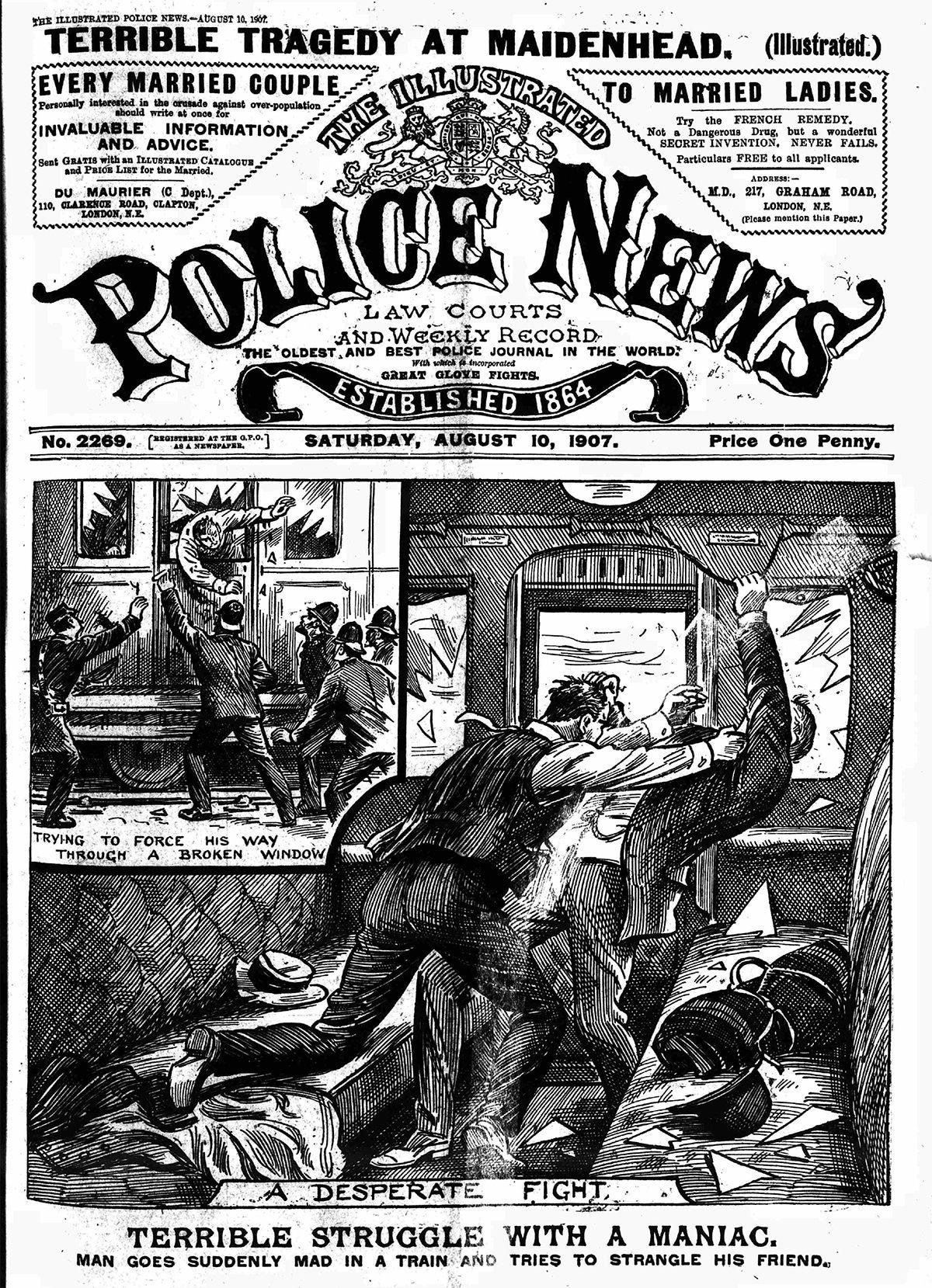
The first passenger trains only went about twenty miles per hour. To people used to the plodding pace of horse-drawn vehicles, twenty miles per hour was a white-knuckle event for body and for mind. By the time Eliot published Middlemarch, express trains could reach 50 or even 60 miles per hour. At first, speed drove people mad. The mind could not keep up with the rapid, relentless pace of modern life. And then — it could. We could. And we humans have been speed demons ever since.
In Middlemarch, Eliot gives us an old, provincial world teetering on the brink of becoming an industrialized, hyper-connected society. Along the way, she asks us to consider how the rise of high-speed transportation prompted an existential shift toward an ideal of high-speed thought. The people of Middlemarch are ruminators — slow, deliberate thinkers whose habits of mind are inextricable from the measured rhythms of rural life. That lifestyle is ending, yielding to a new order in which velocity — mechanical and mental — is becoming a transcendent value. Speed is all, and those who can’t keep up are left behind.
V. Resisting brain rot is a revolutionary act
The pace of change and the pressure to keep up have only increased over time. And, arguably, it is finally reaching its inevitable crashing point. We’ve killed our attention spans, our capacity for critical thinking, and our wellbeing with our endless, distracted scrolling and task-switching. Scientists are calling this “brain rot” — a term coined by Henry David Thoreau all the way back in 1854, to describe a society-wide intellectual decline that was visible even then.
According to a peer-reviewed study published in Brain Science last year, brain rot describes “the cognitive decline and mental exhaustion experienced by individuals, particularly adolescents and young adults, due to excessive exposure to low-quality online materials, especially on social media.” Brain rot, the investigators found, “leads to emotional desensitization, cognitive overload, and a negative self-concept.” It is “linked to psychological distress, anxiety, and depression” which in turn “impair executive functioning skills, including memory, planning, and decision-making.”
The fast society is a shallow society. It’s also a sick society.
Brain rot has made us uniquely vulnerable to ideological manipulation of the most pernicious kind, but we seem neither to notice nor to care. We are living in the “prison without walls,” the “dictatorship without tears” that Aldous Huxley predicted nearly a century ago. “The dictatorships of tomorrow,” he wrote, “will deprive men of their freedom, but will give them in exchange a happiness none the less real, as a subjective experience, for being chemically induced,” he wrote. “People will come to love their oppression, to adore the technologies that undo their capacities to think."
In other words: We can’t think straight, because we can no longer think at all. We have traded our individuality, our freedom, and our future for a dopamine high.
And so my rumination comes full circle with a realization: We must bring back rumination, as a practice, as a way of being, as a positive and essential social, personal, and political good. For rumination done right, done the way nature intended, is how we prevent brain rot — and how we repair it.
To be genuinely thoughtful — this is what we urgently need in order to be genuinely alive. It means slowing down, taking our time to notice, to observe, to consider, to discern, and also, crucially, to decide what we take in — whether we are reading, listening, watching, or scrolling. It also means taking the time to extract the value from what we’ve consumed — to ruminate like a deer does, chewing on ideas the way they chew the irises in my garden.
Slow cooking, slow reading, slow living — these things are on the rise for a reason. To them I would suggest we embrace slow thinking and, yes, slow creativity, creativity of the ruminative sort that Hemingway and Eliot practiced, creativity that offers us a restorative antidote to a world that pushes us out of our minds and into dehumanizing patterns of non-thinking, creativity that is its own reward, a beautiful life-affirming end in itself.
VI. Finally, the end
I’m a ruminative writer, in case that’s not completely obvious by now. When I had the idea for this piece, I thought it would be a quick and easy thing to write. That was a lot of the attraction. I am as subject to the fantasy of frictionless, fast creativity as anyone. I dream of being the kind of writer whose writing writes itself. I know there’s no such thing, but my dreams neither know nor care.
Now here I am, two months later, finally coming to the end of a thought that turned out to be more complicated, more layered, and, to me, anyway, much more interesting, than I had imagined. I’m glad to be finishing up at last, but I am also glad I took my time, that I gave myself space to write this as it demanded to be written, and that I allowed myself to wonder — and wander — along the way.
I didn’t know George Eliot would make an appearance here until she did. I didn’t know I’d be thinking about trains, or brains, or the effect of trains on brains until I was already doing it. I don’t think about Matt Damon very much, and I definitely didn’t think I’d think about him here. But I did.
This, to me, is the magic of writing. Writing is, for me, controlled, creative rumination. It prompts me to think — deeply and deliberately — which in turn allows me to see new things, and to see old things in new ways. Writing also forces me to find words for it all, to do the hard part of getting clear so that I can capture what’s inside my head and then share it with the world. And that feeling is one of the best feelings in this life — precisely because it is a feeling of being intensely intellectually, creatively, and emotionally alive, of being intensely, wholly human.
Jenny Wren is sitting by me as I type these last lines, fluffy and regal, practicing her podium pose. She’s going to need it. This morning, I caught her working on a new routine. It involved a window sill, a decorative pine cone, the Alexa, and an entire shelf of CDs. She’s definitely going to medal.
So much to digest here. Rumination, done well is great editing—rephrasing, refining, tightening, expanding. A sudden insight can be a lot like a an uncut gemstone found crusty, dull and uninteresting, but once the surface is cut, detritus is ground away and the surface is polished, the glorious gem appears. Good writing may take a similar path.
Cats are a constant source of delight, and especially so when they are a source of chaos.